Trump er ved at positionere USA i, hvad nogle kalder den multipolære verdensorden, civilisationernes sammenstød, den post liberale hegemoni osv. Pointen er, at skællene er faldet fra øjnene i USA, realismen er tilbage; stater har interesser og ikke venner, som en naturlig erkendelse. I denne positionering er Trump også ved at omkalfatre en ny verdensorden hvor, hvis alt går vel, Kina vil være mere isoleret og USA genskabt som en global hegemon. Ikke med en liberal dagsorden, men en egen-nyttig sikkerhedspolitik. Forhåbentligt vil det være mindre krigslystent.
Trump har tidligt satset på fred gennem styrke, og hvis ikke det skabte fred, så i det mindste sikkerhed og muligheder gennem styrke. At være energiuafhængig har fra starten af hans første præsidentperiode været central. “Drill baby, drill!” sagde han og USA er nu verdens største olieproducent. Tillige har USA med pågribelsen af diktatoren Maduro fået et medgørligt Venezuela og dermed en form for kontrol med landets enorme oliereserver. Hele det Sydamerikanske kontinent er mere eller mindre faldet ind under amerikansk hegemoni (også Panamakanalen var en del af den tænkning.
Krigen, eller hvad Trumps regering nu kalder det, mod det iranske regime handler ikke blot om det rædselsscenarium at de religiøse galninge skulle forhindres i at udvikle atomvåben til deres ballistiske missiler, vigtigt som det er for os der ikke ser frem til Mahdiens komme, men også om olie. Iran forsyner det meste af Asien og altså også den geopolitiske rival Kina. Så Here’s a fun question to ponder” skrev Coffee And Covid “what if the Iran war wasn’t only about stopping its nuclear program?“
What if the global energy crisis was the primary objective? To see this clearly, just swap a single assumption around. Media assumed that the energy crisis surprised President Trump.
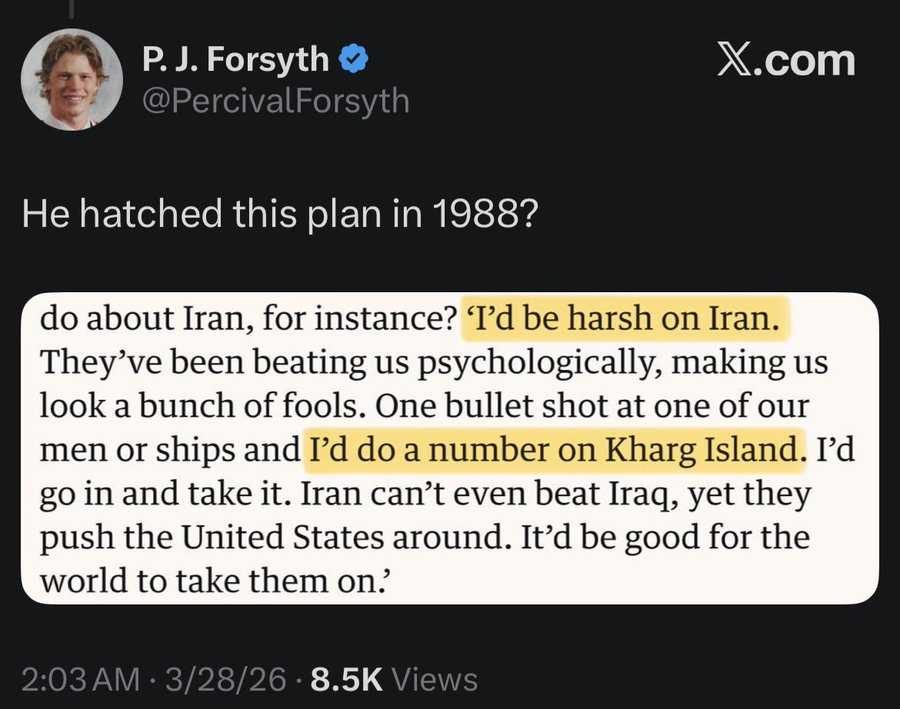
But what if it’s the other way around? What if he knew this would happen? Remember, Trump has been thinking about oil, the Strait of Hormuz, and even tiny Kharg Island since the 1980s.
Den tidligere Speaker of the House, Republikanske Newt Gingrich siger om Trump, “He has been thinking about this at leves that very few American Presidents could match” og siger at Trump “has an enormous depth of knowledge”. Så stor en viden at han er en forudsigelsesmaskine af en anden verden (i direkte konkurrence med Cosmo Kramer)
We’re not leaving! First of all; if you have B2s flying out of Missouri that can bomb you and take out everything, we’re never leaving! Second, if you have aircraft carriers of shore that can defeat anything you’ve got, we’re not leaving! If you have submarines nearbythat have Tomahawk missiles, we’re not leaving! If you have Allies, that have now decided that they are really pissed of with the Iranians – so you have the Saudies, the Kuwaities and others, UAE, much more anti Iran than they were 6 weeks ago.
And there is a secondary part of this; a theme of this administration consistently – going back to Trumps first speech in Warsaw in 2017 – they want the Europeans and others to step up to the plate and do their share. They wanna get the Europeans to take responsebility so that they can pivot to make sure we can overmatch China. This has been very clear if you watch it.
Derfor konkluderer Gingrich at hvis ikke Trump kan sejre hurtigt “he’s gonna grind them down, he is never gonna leave!”.
På Coffee And Covid spekulerer de videre, med baggrund i at Trump i årtier har set sig lun på benzin øen Kharg, i om han gerne ville skabe en global energikrise (det flirter de også med på gCaptain), og at atomtruslen blot er undskyldningen. Det er trods alt europæerne, der er mest afhængige af olien, da Rusland selv producerer sit og Kina har enorme lagre at trække på – indtil videre. Samtidig har Storbritannien spillet sine kort af hænde, med deres manglende støtte til bekæmpelsen af det iranske terrorregime, så olietankerne nu ikke længere forsikres hos Lloyds of London, men af amerikanske forsikringsselskaber. Dermed har USA fået mere end fysisk kontrol med Hormuz strædets olie: “Want your energy flowing again?” spørger de ”Come to Washington.”. På gCaptain leverer de “an alternative Hormuz hypothesis”
The real threat is not $200 oil. It’s a fracture of the system. It is cheap energy in export nations and ruinous energy costs in places far from reserves. It’s $2 oil in the Persain Gulf, $20 dollar oil in the Gulf of America and $2,000 oil in the UK.
One global price only works if there is a surplus of tankers to arbitrage differentials. Before the Iran strikes, that surplus was razor-thin. Now, with supertankers stuck in the Gulf, it is gone.
Brent is at $106 today. WTI is under $100. Domestically, diesel is stabilizing and natural gas prices are falling as LNG that would normally be exported stays trapped at home. Trump issued a 60-day Jones Act waiver and opened Venezuelan oil sales to U.S. companies via a new Treasury license for PDVSA. These are exactly the moves you make if you are trying to drive U.S. prices down while the global market fractures.
Tankers charge by the day, so long-haul routes become comparatively more expensive. Venezuelan crude on short Gulf runs becomes far cheaper for U.S. refiners than Middle Eastern crude routed around the Cape of Good Hope for European or Asian buyers.
Look at who benefits. The three most powerful industry lobbies in the U.S. are tech, Wall Street, and energy. Tech gets cheaper LNG for data centers. Wall Street gets volatility and panic to extract trading profits. Energy companies were just given Venezuela and renewed Gulf access.
Meanwhile, California has been closing refineries and blocking pipelines, forcing gasoline imports from South Korea on ships with dayrates that are skyrocketing. Govenor Newsom, the leading canidate for President in 2028, is irrate. New England imports LNG and diesel by ship. If Hormuz stays closed, prices spike in those states. Deep blue states. Red state energy costs fall. Blue state costs rise. Europe capitulates on major policy disputes between now and the midterms.
Investeringerne er en god indikator for, hvorledes krigen går og hvorhen Verden drejer – det vil sige, hvad Trump ser på. Techbranchen er tæt knyttet til Trumps Hvide Hus, ikke blot grundet de politiske vinde, men fordi de ser en fremtid, der er baseret på andet end blot at censurere borgerne på Systemet CIA’s vegne, som har været en del af deres hidtidige forretningsmodel. Musk er selvfølgelig indlysende, men hvis man har fulgt de fire oprindelige medlemmer af The All In Podcast, alle venturekapitalister mm, så startede de, ligesom Musk, med at være Demokrater – det sympatiske parti, som Musk sagde. I dag arbejder de tre af medlemmerne for Trump.
Og det er ikke fordi de er forblændede af den kejser-gudens orange stråleglans, men en erkendelse af den pragmatiske og realistiske tilgang til storpolitik. Det er også bedre for ens mentale helbred at kæmpe for den frihed Vesten repræsenterer end blot at lave ansigtsgenkendelse-programmer til den kinesiske undertrykkelses-maskine. Så “Let’s discuss an unexpected nexus of power: artificial intelligence.”
A single ChatGPT query uses roughly 10 times as much electricity as a Google search. Scale that to hundreds of millions of queries per day, and you start to understand why the four biggest US tech companies —Amazon, Google, Meta, and Microsoft— are projected to spend between $630 billion and $700 billion on AI data center infrastructure this year alone. That’s a 62% jump over 2025.
By 2030 —only four years hence— total AI-related data center spending in the US is expected to hit $5.2 trillion. There’s never been anything like it. Calling it “historic” fails to capture the gist.
These aren’t just regular computers. They are the most energy-hungry machines ever built. Data centers already consume over 1,000 terawatt-hours of electricity globally— more than 125 million Japanese use in a year for everything. The Electric Power Research Institute recently projected that AI data centers alone could consume up to 9% of all US electricity by 2030.
This week, BlackRock’s Larry Fink plainly said it: AI is not a bubble. Power is the real bottleneck.
Europe was already losing the AI arms race. But now it’s over. The fat German lady has sung, left the opera, and is home tucking into a bratwurst.
Even before the Iran war, industrial electricity in Europe cost roughly twice what it costs in the United States. Three days ago, Fortune reported that the gap is widening. On March 13th, the New York Times reported that surging energy costs put German industry “really in danger.”
Og mens energikrisen kun kan blive værre siger “The Draghi Report—the EU’s landmark competitiveness review—already estimated that 70% of Europe’s GDP-per-capita gap with the US stems from lower productivity, driven primarily by a technology-sector gap.” I det mindste sidder vi stadig fast i en udsigtsløs krig med Rusland i Ukraine mens vi venter på, hvilket land først ender i en muslimsk drevet borgerkrig eller den totalitære tilstand, der skal til for at forhindre det. Med Trumps ord “Very bad things have happened to Europe, you better do something about immigration and energy or you won’t have a Europe”
AI isn’t just the latest wave of technology, like tablet phones, streaming music, or LED bulbs that don’t work. It’s a civilizational sorting mechanism. It’s the new dividing line between first-world and second-world powers. Countries leading in AI will dominate economically, militarily, and diplomatically for the next hundred years.
Countries that fall behind won’t just lose market share. They’ll lose relevance.
Thanks to the energy crisis, Europe is staring down that horrifying possibility right now.
At Davos, Macron begged for “sovereignty and autonomy.” But he can’t declare sovereignty when France can’t keep the lights on. They can’t build data centers when their electricity costs are double their competitors’ rates, and their grid is three energy shocks deep in the consommé.
The last time a technology revolution reshaped the global order this completely was the Industrial Revolution. The countries that industrialized first —Britain, Germany, and the United States— dominated the next two centuries. The countries that lagged behind became colonies, clients, or just … irrelevant.
AI is the sequel. It is the next revolutionary era. Whether or not anyone is saying it, the Industrial Revolution is over, and we have launched into the Intelligence Revolution.
And right now, Europe is missing the revolutionary bus. It hasn’t even bought a ticket yet. It doesn’t even know where the ticket counter is, because it is hidden somewhere behind a windmill farm.
Og mullaherne bomber ikke vindmøller, som mange pointerer. What is new in this war with Iran is that the United States, under Donald Trump, has chosen not to rush to “solve” the problem” istemmer James E Thorne: “In Hegelian terms, he is refusing an easy synthesis in order to force the underlying contradiction to the surface“.
“Apart from strongly-worded messages, Russia and China have been conspicuously silent” noterer de, noget der uanset hvad, er bemærkelsesværdigt og vidner om at den amerikanske regering har så meget fat i den lange ende, at de konkurrerende stormagter kan slå sig til tåls med det færdige resultat. Stabilitet er trods alt det vigtigste.
På podcasten The Duran er man forståeligt nok pessimistiske, som de ser Iran krigen koagulere med krigen i Ukraine til en uoverskuelig geopolitisk katastrofe, som de formulerer det. At forhandle en løsning i Ukraine synes også noget nær umuligt, med russernes krav på de territorier, de har annekteret overfor Ukraines insisteren på at få alt besat land tilbage. Trump lovede lidt frivolt at ende krigen på den første dag på kontoret, og dette har han ikke gjort – endnu.
Mange har stillet spørgsmål ved, hvorfor Trump ikke blot har trukket stikket for støtten til Ukraine og fået dem til at kapitulere en forhandlet fred. Dette ville blot gøre russerne til suveræne sejrherrer, og det er politisk uspiseligt i Vesten. Men med en reorganisering af verdensordenen bliver grænser og postnumre i Donbas en mindre, hvis ikke ligegyldig detalje, som vi ser på at få Kina inddæmmet og vinde kapløbet om morgendagens teknologi og magt.
“When you go to a bank, and you borrow $3 million, and you can’t pay it back, you’ve got a problem” havde Trump engang betroet Stephen A Schmidt “But when you go to a bank, and you borrow $300 million, and you can’t pay it back, WE’VE got a problem”. Med andre ord er banken tvunget til at sikre dig succes.
Så det er kun Europa, der ledes af bureaukrater og politikere af gårsdagens paradigme, der insisterer på at holde liv i den tabte krig uden at have noget at tilbyde de nye stormagter. Nå, vi kan vel altid sortere vores affald…
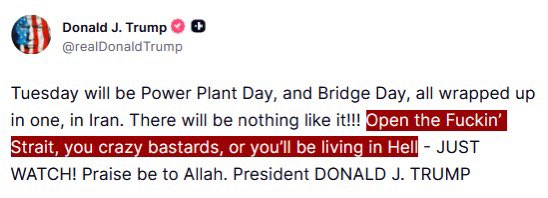
Også James E Thorne ser en bevidst strategi fra Det Hvide Hus side, der “is refusing an easy synthesis in order to force the underlying contradiction to the surface” og har slet ikke travlt med at åbne strædet. Med udgangspunkt i Hegels ide om et negativt øjeblik for at ændre historien
Trump’s antithesis is to withhold the automatic guarantee at the moment of maximum stress. Militarily, the US can break Iran’s residual ability to contest the Strait; that is not the binding constraint. The point is to delay that act. By allowing a closure or semi‑closure to bite, Trump ensures that the immediate pain is concentrated in exactly the jurisdictions that have most conspicuously free‑ridden on US power: the EU and the UK. Their industries, consumers and energy‑transition assumptions are exposed.
In that context, his reported blunt message to European and British leaders, you need the oil out of the Strait more than we do; why don’t you go and take it? Is not a throwaway line. It is the verbalisation of the antithesis. It openly reverses the traditional presumption that America will carry the burden while its allies emote from the sidelines.
In this dialectic, the prize is not simply the reopening of a chokepoint. The prize is a reordered system in which the United States effectively arbitrages and controls the global flow of oil. A world in which US‑aligned production in the Americas plus a discretionary capability to secure,or not secure, Hormuz places Washington at the centre of the hydrocarbon chessboard. For that strategic end, a rapid restoration of the old status quo would be counterproductive.
Hvis ikke man vil lytte må man føle.
På sin vis er Kina en parasit, der ser ud til at have fortæret sin værstsorganisme, den Liberale Verdensorden. Realismen har aldrig været væk. Men ærligheden i dens rå virkelighed har været perverteret i et selvgodt paradigme, der mere eller mindre kun har bragt ulykker med sig. Ægte frihed, sagde filosoffen, hviler på erkendelsen af nødvendigheden.
 MONOKULTUR
Skriv en kommentar